
ACL reconstruction in Turkey: get a stable knee back
Anterior cruciate ligament tear, whether to operate, techniques, price, rehabilitation and return to sport: everything you need to know before ACL surgery in Turkey.
What is ACL reconstruction in Turkey?
The anterior cruciate ligament (ACL) stabilizes the knee. It often tears during a twisting movement, when skiing or playing football or basketball. The knee can then “give way” when changing direction, and repeated episodes damage the meniscus and cartilage.
ACL reconstruction in Turkey replaces the torn ligament with a tendon, most often taken from around the knee. It is done by arthroscopy, through small incisions, and takes about 1 hour to 1 hour 30 minutes, usually with 1 night in hospital. Plan on 5 to 7 days in Turkey. Surgery usually costs $3,500 to $8,000, and the price is confirmed in a free quote.
TurquieMed organizes your stay: forwarding your file to the orthopedic surgeon, opinion and detailed quote within 48 hours, airport pick-up, transfers, hotel, interpreter and 7-day-a-week assistance.
To choose well, remember that rehabilitation lasts several months: plan a physiotherapist close to home from the start.
- Surgery time
- About 1 hour to 1 hour 30
- Hospital stay
- Usually 1 night
- Stay in Turkey
- Usually 5 to 7 days
- Price
- $3,500 to $8,000
How much does ACL reconstruction cost in Turkey?
In Turkey, ACL reconstruction usually costs $3,500 to $8,000. The price depends on the technique, the fixation hardware, any associated meniscus repair, the length of the hospital stay and the hospital. For a comparable level of care, it is often much lower than private prices in Western Europe or North America.
Your free quote, prepared after your MRI has been reviewed, specifies the surgery, the hospital stay, a brace and crutches if needed, medication, physiotherapy on site, the hotel, transfers and interpreter. Your flight is usually at your own expense.
Why choose Turkey for ACL reconstruction?
After an ACL tear, waiting too long for surgery increases the risk of damaging the meniscus. In Turkey, surgery can usually be scheduled quickly after the opinion.
1. Knee and sports surgeons
ACL reconstruction is entrusted to orthopedic surgeons specialized in the knee, used to treating athletes.
2. Arthroscopy
Surgery is done through small incisions, with a camera, which limits pain and makes recovery easier.
3. A short stay
Usually one night in hospital, a few days of check-ups, then you go home to continue rehabilitation.
4. A price known in advance
Surgery usually costs $3,500 to $8,000, often much less than private care in Western Europe or North America. The quote details each item.
5. The meniscus treated at the same time
If the MRI shows a meniscus injury, the surgeon repairs or treats it during the same arthroscopy, without a second operation.
6. A stay organized from A to Z
We organize your appointments, a hotel close to the hospital, transfers and an interpreter, with 7-day-a-week assistance. You leave with your surgical report, your prescriptions and your rehabilitation program.
| In Turkey with TurquieMed | Often elsewhere | |
|---|---|---|
| First opinion | Within 48 hours, free, based on your MRI | Several weeks for an appointment |
| Time before surgery | Usually a few weeks | Often several months |
| Price | Usually $3,500 to $8,000, with a detailed quote | Often much higher in private care |
| Support | Hotel, transfers, interpreter, assistance 7 days a week | To be organized yourself |
How do you know if your ACL is torn?
An ACL tear is often recognized by a typical accident: a twisting knee with the foot stuck on the ground, when changing direction, landing from a jump or falling while skiing. The most common signs are:
- a pop felt or heard at the time of the accident;
- a knee that swells in the following hours;
- pain that often prevents you from continuing the sport;
- later, a feeling of instability: the knee “gives way” when changing direction or on stairs.
Diagnosis is based on examination of the knee by a doctor, who tests its stability, and on an MRI, which confirms the tear and shows associated injuries to the meniscus or cartilage. An X-ray checks that there is no fracture. After the accident, ice, rest, a brace and crutches if needed bring relief while waiting for the opinion.
Other injuries can come with the tear: a sprain of the medial collateral ligament, which usually heals with a brace, a bone bruise visible on the MRI, or more rarely a tear of the posterior cruciate ligament or the outer structures of the knee. The surgeon takes them into account to choose the timing and technique of surgery.
Does an ACL tear always need surgery?
No: not every tear is operated on. Surgery is mainly recommended in case of:
- a knee that gives way in daily life or during sport, despite rehabilitation;
- pivoting sports (football, basketball, handball, skiing, tennis) that you want to return to;
- an associated meniscus injury that needs repair;
- a physical job that puts a lot of strain on the knee.
A partial tear, when part of the ligament remains intact, can often be treated with rehabilitation alone, especially if the knee stays stable. On the other hand, waiting several months with a knee that gives way exposes you to meniscus and cartilage injuries, which do not always heal.
For a less sporty person whose knee remains stable, rehabilitation alone may be enough. Surgery is usually done a few weeks after the accident, once the knee has lost its swelling and regained its mobility. See also our page on orthopedic surgery in Turkey.
What techniques are used to reconstruct the ACL?
The new ligament is made from one of your tendons, passed through small tunnels drilled in the femur and tibia, then fixed with screws or buttons.
- The hamstring tendons (at the back of the thigh): the most widely used technique, with a small scar;
- The patellar tendon: very strong fixation, often chosen for high-level athletes;
- The quadriceps tendon: an increasingly used alternative.
The surgeon chooses with you according to your age, your sport and the condition of your knee.
The meniscus and cartilage
An ACL tear often comes with a meniscus injury. When possible, the surgeon stitches it to preserve the meniscus, which protects the cartilage in the long term; otherwise, they remove only the damaged part. A meniscus repair may require a few extra weeks of precautions.
Lateral reinforcement
In some young, very sporty patients or those with a very unstable knee, the surgeon may add a small reinforcement on the outer side of the knee to reduce the risk of another tear. They tell you whether it is useful in your case.
Anesthesia
Surgery is done under general or spinal anesthesia, often with a nerve block in the thigh that relieves pain for the first hours. Most patients get up the same day or the next day.
How to prepare for ACL reconstruction?
A well-prepared knee recovers faster. Before surgery, the goal is to arrive with a knee that has lost its swelling, straightens fully and bends well, and a thigh as strong as possible.
- Do a few weeks of rehabilitation with a physiotherapist: regain full extension, reduce swelling and strengthen the thigh;
- Avoid pivoting sports while waiting for surgery, so as not to damage the meniscus;
- Mention your medication, especially hormonal contraception or an anticoagulant, which matter for the risk of blood clots;
- Book a physiotherapist for the week of your return: rehabilitation must start without delay.
In your suitcase: shorts or wide trousers that fit over a brace, stable shoes, your medication and your MRI.
How does ACL reconstruction in Turkey work?
- You send us your request. Through the website form or on WhatsApp, with your knee MRI and its report.
- The surgeon reviews your file. They tell you whether surgery is recommended, and when.
- You receive your care plan and quote. Within 48 hours: the proposed technique, the length of stay and a detailed price, free and with no obligation.
- We organize your trip. Hospital appointments, hotel, airport transfer and interpreter.
- Surgery. Check-up on arrival, arthroscopic surgery, usually one night in hospital, first physiotherapy sessions and a check before going home.
- Going home. You leave with your surgical report, your prescriptions and your rehabilitation program.
After surgery
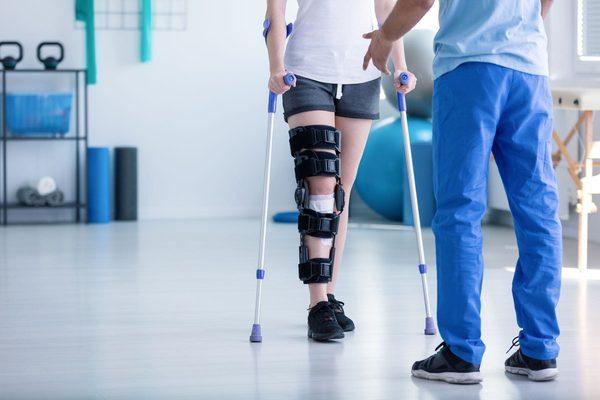
You walk with crutches for 2 to 4 weeks, sometimes with a brace. Rehabilitation continues at home for several months: running usually resumes around 3 to 4 months, and pivoting sports around 9 months, after an assessment. A treatment against blood clots is often prescribed for a few weeks. Flying is usually possible after the check, a few days after surgery.
What is rehabilitation like after ACL reconstruction?
Rehabilitation usually lasts 6 to 9 months before returning to pivoting sports. It progresses in stages, and each stage is validated by progress, not only by the calendar. The timings below are average guides.
| When | Usual goals |
|---|---|
| Weeks 0 to 2 | Reduce swelling, regain full extension, walk with crutches |
| Weeks 2 to 6 | Give up the crutches, bend the knee beyond 90 degrees, exercise bike |
| Months 2 to 3 | Strengthen the thigh, balance, normal walking, driving |
| Months 3 to 4 | Running in a straight line, if the knee is dry and strong |
| Months 4 to 6 | Jumps, gradual changes of direction, non-pivoting sports |
| Months 6 to 9 | Strength and jump tests, training specific to your sport |
| From 9 months | Return to pivoting sports and competition, after approval |
Exercises in the first weeks
- Fully straightening the knee, heel resting on a cushion, several times a day;
- Tightening the thigh, leg straight, for a few seconds;
- Bending the knee by sliding the heel, without forcing;
- Straight leg raises, lying on your back;
- Pedaling on an exercise bike, once the knee bends enough.
Work and driving
Office work usually resumes after 1 to 3 weeks, keeping the leg raised when possible. A physical job, standing or carrying loads, often requires 2 to 3 months, sometimes more. Driving resumes around 4 to 6 weeks after surgery on the right knee, earlier for the left knee with an automatic car, once you can brake hard without pain.
When can you safely return to sport?
The return to pivoting sports is decided on criteria, not just on a date: a thigh almost as strong as the other one, successful jump tests, a knee without swelling and good confidence in your knee. Returning before 9 months, or before passing these tests, clearly increases the risk of another tear. A prevention program, with balance and landing exercises, remains useful after returning to sport.
What results can you expect after ACL reconstruction?
The vast majority of operated patients get a stable knee back, which no longer gives way in daily life or during sport. Most return to sport; however, returning to exactly the same level, especially in competition, is not always possible and depends a lot on rehabilitation, motivation and the sport practiced.
In the long term, a knee that has had an ACL tear keeps a higher risk of osteoarthritis, especially if the meniscus was damaged or removed. Operating on an unstable knee, preserving the meniscus when possible, keeping strong muscles and a stable weight help protect the cartilage for years.
What are the risks of ACL reconstruction?
ACL reconstruction gives the vast majority of patients a stable knee. Like all surgery, it carries risks, discussed with the surgeon before any decision.
| Possible complication | Good to know |
|---|---|
| Knee stiffness | Limited by rehabilitation started in the first days |
| Blood clot | Prevented by anticoagulant treatment and getting up early |
| Pain where the tendon was taken | Often temporary |
| Another tear | More common when returning to sport too early |
| Infection | Rare, to be treated quickly |
How to choose your hospital and quote?
A low price is not enough. Ask the hospital these questions before committing:
- Is the hospital authorized by the Turkish Ministry of Health to treat international patients?
- Who will perform the surgery, and how experienced are they with this technique?
- Which tendon will be used, and why for you?
- Is a possible meniscus repair included in the quote?
- Who takes care of a complication, on site and after your return home?
- What and rehabilitation follow-up is planned, and with whom?
What a good quote should specify
- The name of the hospital and the doctor
- The tests, anesthesia, hospital stay and medication included
- The number of nights in hospital and at the hotel, and the transfers
- What happens in case of complication or cancellation
- The follow-up offered after your return
Also budget for your flight and follow-up consultations. Planned treatment in Turkey is usually not covered by public health insurance: ask your insurer in writing before committing.
Our partner hospitals in Turkey








Frequently asked questions about ACL reconstruction in Turkey
How much does ACL reconstruction cost in Turkey?
Usually $3,500 to $8,000, depending on the technique, the fixation hardware, any associated meniscus repair and the hospital. The exact price appears on your free quote.
How long do I need to stay in Turkey?
Usually 5 to 7 days: check-up, surgery, one night in hospital, first physiotherapy sessions and a check before going home.
When can I return to sport?
Running usually resumes around 3 to 4 months, and pivoting sports (football, skiing, basketball) around 9 months, after assessing the strength and stability of the knee. Returning too early increases the risk of another tear.
When can I fly after surgery?
Usually a few days after surgery, after the check, with a treatment against blood clots. During the flight, move your legs and get up regularly.
Should I have surgery quickly after the accident?
Not immediately: surgery is usually done a few weeks after the accident, when the knee has lost its swelling and regained its mobility. You should not wait too long either if the knee gives way, to protect the meniscus.
Is ACL surgery painful?
The operation itself does not hurt, as you are under anesthesia. In the first days, pain is controlled by medication, cold packs and rest with the leg raised. It decreases clearly within one to two weeks.
Can you live without an ACL?
Yes, some less sporty people live without an ACL, with a stable knee thanks to well-trained muscles. But if the knee gives way, each episode can damage the meniscus and cartilage: surgery is then recommended.
Which tendon is best to replace the ligament?
There is no single best tendon for everyone. The hamstrings, patellar tendon and quadriceps tendon all give good results; the surgeon chooses according to your age, sport, job and the condition of your knee.
What is the risk of another tear?
It is low for most patients, but higher in young athletes who return to a pivoting sport too early. Following the stages of rehabilitation and passing the tests before returning clearly reduces this risk.
Do I need to wear a brace after surgery?
Not always. Many surgeons do not use one, or only for a few days. A brace is more often prescribed after a meniscus repair or an associated injury to another ligament, for a few weeks.
When can I walk without crutches?
Usually after 2 to 4 weeks, when the knee straightens fully, the thigh contracts well and you walk without limping. After a meniscus repair, weight-bearing may be limited a little longer.
Can a teenager be operated on?
Yes, with adapted techniques that protect the growth plates. The decision and the operation are made by a surgeon experienced with teenagers’ knees, depending on age and remaining growth.
What documents should I send for an opinion?
Your knee MRI and its report, your doctor’s report, the date and circumstances of the accident, and your level of sport.
Is surgery in Turkey covered by insurance?
Planned surgery in Turkey is usually not covered by public health insurance systems, which generally only reimburse urgent and unforeseen care abroad. Physiotherapy after your return is often covered at home. Some private insurers and international health plans do cover treatment abroad: ask your insurer in writing before committing, and keep all your invoices and medical reports.
Request a free medical opinion and quote
Send us your X-rays, MRI or CT scan and your medical reports. An orthopedic surgeon will review your file, and you will receive a detailed medical opinion and an estimated quote.
 Our advisors present the options suited to your case in Turkey